
Top Car Condenser Manufacturers in China Market Trends Leading Innovations and Future Outlook

China has become one of the most important production bases for automotive thermal management. That includes car condensers, the heat exchangers that allow an air conditioning system to reject heat and cool the cabin.
Demand is no longer driven only by basic passenger comfort. Automakers now need lighter, more efficient, and more durable condenser systems for gasoline vehicles, hybrids, and electric vehicles. At the same time, aftermarket buyers want stable supply, consistent fit, and competitive pricing.
The result is a large and highly active condenser market with several types of suppliers:
Domestic thermal management specialists with strong aluminum heat exchanger production
Vehicle air conditioning system companies serving OEM and fleet markets
Global Tier 1 suppliers with major manufacturing operations in China
Aftermarket-focused manufacturers exporting replacement condensers worldwide
Below is a practical look at the manufacturers shaping the market, what they do well, and where the sector appears to be heading.

The automotive condenser market in China is moving toward higher performance
China’s car condenser market benefits from the size of the country’s vehicle industry. Domestic automakers, joint ventures, export programs, and a large replacement parts channel all create steady demand.
A condenser may look simple from the outside, but performance depends on precision. Fin density, tube geometry, brazing quality, corrosion protection, leak control, and refrigerant compatibility all affect cooling performance and service life.
Several market forces are shaping product development.
Electric vehicles need more advanced thermal systems.
EVs use heat pumps, battery thermal management, and integrated cooling loops. That places new demands on condenser and heat exchanger design.
Lightweight aluminum construction is standard.
Most modern condensers use aluminum microchannel designs because they reduce weight and improve heat transfer compared with older tube-and-fin systems.
Export buyers expect global fit and quality control.
Manufacturers serving North America, Europe, the Middle East, and Southeast Asia need reliable packaging, stable part numbers, pressure testing, and clear documentation.
Aftermarket demand remains strong.
Condensers are exposed to stones, road salt, vibration, and corrosion. Replacement demand continues even as new vehicle designs change.
The strongest suppliers are not only making condensers. They are building complete thermal management capability around the vehicle platform.
Leading car condenser manufacturers in China
The companies below are widely recognized in China’s automotive thermal management and air conditioning supply chain. Some are Chinese-owned groups, while others are global suppliers with a large manufacturing footprint in China. The list is not a formal ranking, but it reflects the kinds of companies buyers often evaluate when sourcing condensers.
Manufacturer | Main strength | Typical focus |
Zhejiang Yinlun Machinery | Thermal management systems and aluminum heat exchangers | Passenger vehicles, commercial vehicles, EV thermal systems |
Sanhua Automotive | Thermal control components and integrated systems | EVs, HVAC systems, valves, heat pump components |
Songz Automobile Air Conditioning | Vehicle air conditioning systems | Buses, commercial vehicles, passenger vehicle HVAC |
Nanning Baling Technology | Automotive air conditioning heat exchangers | Condensers, evaporators, radiators, aftermarket and OEM channels |
Guangzhou Jingyi Automobile Air Conditioner | Vehicle AC systems and components | Buses, commercial vehicles, AC assemblies |
Hanon Systems China | Global thermal management production in China | OEM passenger vehicles and EV systems |
Valeo China | Global HVAC and thermal systems | OEM programs, compact systems, EV thermal management |
Denso China | High-volume automotive HVAC components | OEM supply, quality-driven thermal components |
Zhejiang Yinlun Machinery is a major domestic thermal management supplier
Zhejiang Yinlun Machinery is one of China’s better-known thermal management companies. Its business covers heat exchangers and related systems for passenger cars, commercial vehicles, construction machinery, and new energy vehicles.
For condensers, Yinlun’s strengths come from its broader heat exchanger background. The company has experience with aluminum brazing, compact heat exchanger structures, and integrated vehicle cooling products.
Key areas that set Yinlun apart include:
Wide thermal management portfolio Condensers sit alongside radiators, oil coolers, charge air coolers, and EV thermal products.
Experience with new energy vehicles EVs and hybrids need coordinated cabin, battery, motor, and power electronics cooling. Companies with system-level knowledge have an advantage.
Manufacturing scale Large production capacity helps support OEM programs and long-term supply agreements.
For buyers who want more than a single replacement component, Yinlun is often evaluated as a broader system partner.
Sanhua Automotive is strong in EV thermal control
Sanhua is widely associated with thermal control technology, especially valves, electronic expansion valves, heat pump parts, and related HVAC components. Its automotive business has become closely linked with electric vehicle thermal management.
Sanhua may not be viewed only as a traditional condenser maker. Its value lies in how condensers interact with the full refrigerant circuit. As EV platforms rely more on heat pumps, the condenser becomes one part of a larger system involving valves, chillers, sensors, and control logic.
Important strengths include:
Strong refrigerant control knowledge
Focus on EV heat pump systems
Integration of components across the HVAC loop
Experience supplying high-volume vehicle platforms
This makes Sanhua especially relevant as the role of the condenser changes from a stand-alone heat exchanger to part of a more complex thermal network.
Songz Automobile Air Conditioning has deep system experience
Songz Automobile Air Conditioning is known for vehicle AC systems, especially in buses and commercial vehicles. It has also been active in passenger vehicle HVAC and electric vehicle thermal products.
Its condenser capability is tied to complete air conditioning system design. For bus, coach, and fleet vehicle applications, the condenser must handle heavy-duty operating cycles, long service hours, and demanding climate conditions.
Songz stands out for:
Complete AC system design
Commercial vehicle experience
Fleet-focused durability requirements
Knowledge of electric bus thermal management
For buyers in the commercial vehicle segment, system knowledge often matters as much as the condenser itself. A larger vehicle may require rooftop units, high-capacity condensers, and coordinated control systems.
Nanning Baling Technology serves both OEM and aftermarket demand
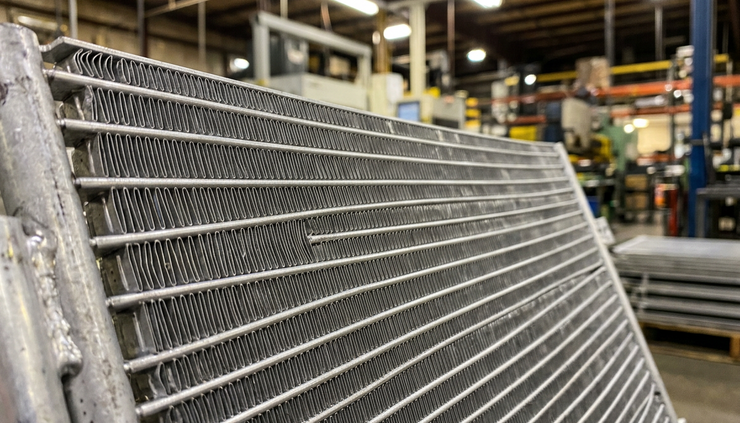
Nanning Baling Technology is often associated with automotive heat exchanger products, including condensers, evaporators, radiators, and related AC components. Companies in this category play an important role in China’s aftermarket and export supply chain.
A strong aftermarket condenser supplier must manage two challenges at once. It needs broad vehicle coverage, and it must keep quality consistent across many part numbers. Fit, bracket accuracy, port placement, and packaging quality can determine whether a product performs well in real service.
Nanning Baling’s typical strengths include:
Broad heat exchanger product range
Replacement parts coverage
Support for export channels
Experience with common passenger vehicle applications
Aftermarket-focused manufacturers are especially important for distributors that need regular supply, mixed orders, and dependable carton labeling.
Guangzhou Jingyi Automobile Air Conditioner focuses on complete AC solutions
Guangzhou Jingyi Automobile Air Conditioner is another supplier known in vehicle air conditioning, with particular relevance in bus and commercial vehicle applications.
For condenser production, this type of manufacturer brings practical knowledge of complete system performance. That includes condenser size, fan matching, refrigerant flow, vibration resistance, mounting design, and service access.
Its strengths tend to include:
AC units and system assemblies
Commercial vehicle and bus applications
High-capacity cooling designs
Custom solutions for vehicle builders
Commercial vehicle condensers face different conditions than small passenger car condensers. They may operate for longer daily hours, in higher load cycles, and under more vibration. Manufacturers familiar with these conditions can offer stronger application support.
Global Tier 1 suppliers play a major role in China
Several global automotive thermal management companies manufacture in China and supply local and international vehicle programs. These companies are important because they raise expectations for quality systems, validation, and platform engineering.
Hanon Systems China supports large OEM programs
Hanon Systems is a global thermal and energy management supplier with operations in China. Its condenser-related work fits into a broader range of HVAC, compressor, heat pump, and EV thermal products.
Hanon’s strengths include system engineering, validation processes, and experience with global vehicle manufacturers. For OEMs, that can reduce risk during development.
Valeo China brings compact thermal system knowledge
Valeo has a long history in automotive HVAC and thermal systems. In China, its operations support local and global automakers, including programs that require compact packaging and high energy efficiency.
Valeo is especially relevant where condenser performance must fit tight front-end module space or connect with advanced HVAC and EV heat pump designs.
Denso China is known for quality-driven HVAC components
Denso is one of the world’s major automotive component suppliers. Its China operations support OEM supply chains across many product categories, including HVAC and thermal components.
Denso’s advantages often center on process discipline, durability testing, and consistent production quality. That matters for condensers because small defects can lead to leaks, poor cooling, or early corrosion.
What separates the best condenser manufacturers
Price matters in condenser sourcing, but it should not be the only filter. The lowest-cost part can become expensive if it causes warranty claims, shipping damage, or fitment issues.
The best suppliers usually stand out in five areas.
Strong aluminum brazing control
Most modern condensers rely on controlled atmosphere brazing. Poor brazing can cause weak joints, internal blockage, or leaks. Good manufacturers monitor furnace conditions, material cleanliness, flux application, and post-braze inspection.
Reliable leak and pressure testing
Each condenser should meet pressure and leak standards for the intended refrigerant system. Strong suppliers use repeatable testing, clear inspection records, and defined rejection criteria.
Accurate fit and vehicle coverage
A condenser must match the vehicle’s mounting points, line connections, sensors, and front-end packaging. In the aftermarket, small dimensional errors can create installation problems.
Corrosion protection for real road conditions
Condensers sit at the front of the vehicle, where they face water, debris, salt, and insects. Better manufacturers offer coatings, material choices, and fin designs that improve durability in harsh conditions.
Technical support and customer service
Good suppliers respond with drawings, samples, test data, packaging details, and clear lead times. This is especially important for importers, distributors, and vehicle manufacturers managing several condenser models at once.
Market trends shaping the future of condensers in China
The next stage of China’s condenser market will be shaped by electric vehicles, refrigerant changes, and more integrated thermal systems.
EV heat pumps will change product design.
Condensers may work with chillers, evaporators, and heat exchangers in more flexible ways. Some systems change function depending on heating or cooling mode.
Compact front-end packaging will keep pressure on engineering.
Automakers want more cooling performance in less space. Suppliers will need better fin design, lower air-side resistance, and lighter assemblies.
Refrigerant compatibility will matter more.
Global markets are moving toward lower-global-warming-potential refrigerants. Suppliers that understand pressure, sealing, and material requirements will be better positioned for export programs.
Smart manufacturing will improve consistency.
Automated fin forming, tube assembly, brazing control, and leak testing can reduce variation. For high-volume parts, consistency is often the difference between a good sample and a good production run.
Aftermarket catalogs will become more data-driven.
Distributors increasingly need accurate cross-references, OE-style fitment data, photos, and packaging information. The best replacement condenser suppliers will compete on service as well as manufacturing.
How to evaluate a Chinese car condenser supplier
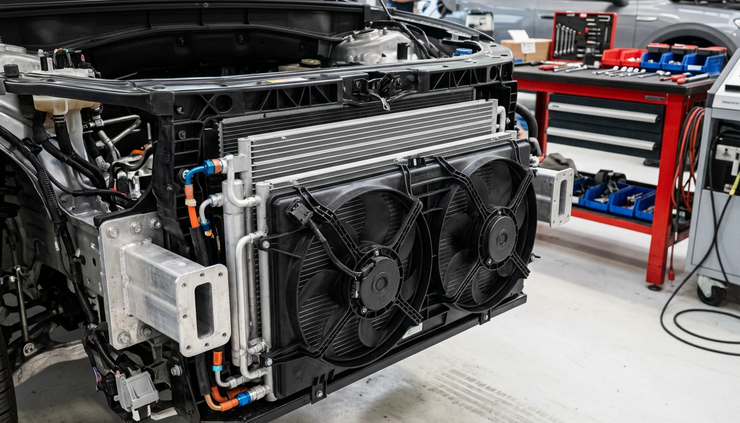
A good sourcing process should look beyond a catalog photo. Before choosing a supplier, buyers should request practical proof of capability.
Useful checks include:
Sample inspection for fin quality, port alignment, and bracket accuracy
Leak test and pressure test documentation
Material specifications for tubes, fins, headers, and coatings
Packaging review for export shipping and warehouse handling
Warranty history and claim handling process
Production capacity for both peak and repeat orders
Support for private label, barcodes, and fitment data if needed
For OEM projects, the review should also include validation plans, design support, and long-term production stability. For aftermarket sourcing, part coverage, MOQ flexibility, and shipment reliability may matter more.
Future outlook for China’s car condenser industry
China’s condenser manufacturers are likely to remain highly competitive. The country has a strong base in aluminum heat exchanger production, a large domestic vehicle market, and fast growth in new energy vehicles.
The biggest opportunities will come from three areas.
First, EV thermal management will create demand for more advanced heat exchangers and system knowledge. Suppliers that can support heat pump platforms will gain an advantage.
Second, export markets will continue to reward reliable aftermarket manufacturers. Buyers will favor suppliers that combine good pricing with fitment accuracy, stable packaging, and responsive service.
Third, quality expectations will keep rising. As more Chinese automakers expand overseas, condenser suppliers will need to meet stricter validation, warranty, and documentation requirements.
The top car condenser manufacturers in China are no longer competing only on production cost. Their future will depend on engineering depth, quality control, vehicle platform knowledge, and the ability to support both OEM and aftermarket customers. For buyers, the best partner is the one that can deliver the right combination of performance, consistency, and service across the full life of the product.


Comments